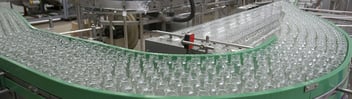
The best food-grade grease for a bottling line depends on which component is being lubricated. Bottling lines contain bearings, chains, conveyors, guides, seals, gears and other components, so lubricant selection should be based on each application's load, speed, temperature, water exposure and food-contact risk.
There is no single grease that is automatically best for an entire bottling line.
Why are bottling lines challenging to lubricate?
Bottling and beverage production can combine:
Frequent washdown
-
Water exposure
-
Cleaning chemicals
-
High production speeds
-
Continuous operation
-
Bearings and conveyor systems
-
Chains and sprockets
-
Seals and O-rings
-
Potential incidental food or beverage contact
The lubricant therefore needs to perform mechanically while remaining appropriate for a food-production environment.
What grease should be used on bottling-line bearings?
For bearings, selection should consider load, speed, temperature and water exposure.
A fully synthetic H1 grease such as Activate Foodcare Longlife is designed for ball, roller and plain bearings and is specified for light through heavy loads. This EP grease has an operating range of -40°C to +220°C and high resistance to water and chemical washout.
That does not mean it is automatically the right choice for every bottling-line bearing; the machine's requirements should always be checked.
What about conveyor chains?
Conveyor chains can require a different lubrication method.
Activate Foodcare Spray Grease is designed for light-to-medium load chains, sprockets, conveyors and similar applications. It is fully synthetic and is NSF H1 registered.
Where slat conveyors are involved, Activate Foodcare Slatglide is specifically developed for slat conveyors and conveyor chains.
What about seals?
Seals and O-rings should be assessed separately.
A suitable silicone grease can help maintain sealing performance while providing lubrication.
Activate Foodcare Sealcare is a fully synthetic silicone grease designed for seals and O-rings, with NSF H1 registration and WRAS approval.
What should bottling plants look for in a food-grade grease?
A useful selection checklist is:
Food safety
-
Correct NSF classification
-
Appropriate for incidental/direct-contact risk
Engineering
-
Load
-
Speed
-
Temperature
-
Water resistance
-
Chemical resistance
Maintenance
-
Relubrication interval
-
Application method
-
Compatibility
-
Storage
Can automatic lubrication help bottling lines?
Yes.
Where lubrication points are suitable for automatic systems, automatic lubrication can help deliver the correct quantity at the required interval and reduce reliance on manual intervention.
Activate positions automatic lubrication as a way of improving consistency and protecting assets.
The key takeaway
The best grease for a bottling line is not necessarily one product. It is the right food-grade lubricant for each lubrication point.
A structured lubrication survey can identify where bearings, chains, conveyors and seals require different products and where rationalisation or automatic lubrication could improve reliability.